

Author: Robert “Ninja” Porras | CEO/Founder NinjaBobSolutions LLC
“The views expressed here are my own and do not reflect those of any specific manufacture or organization . This is provided for general informational purposes only so you can make an informed decision based on your needs – not someone else’s agenda. While I do my best to share accurate and current information, I make no guarantees about completeness, reliability, or results. Any action you take based on this content is at your own risk.”
Everyday pistol carry with an appendix holster is just one of several effective options for carrying a sidearm in daily life. There is no one-size-fits-all method. The right choice begins with an honest assessment of your environment, your mission, and the risks you may realistically face.
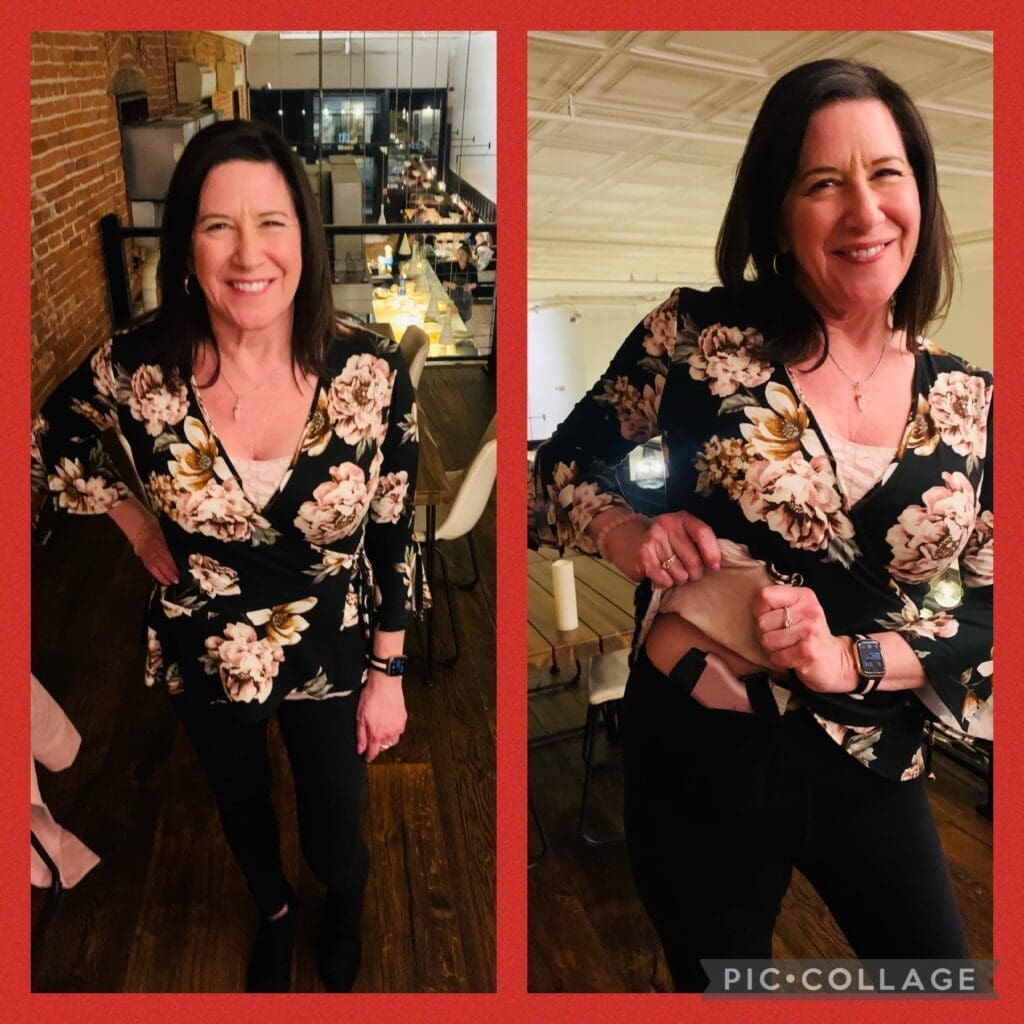
What you are doing, where you are going, and the overall threat environment are some of the most important factors to consider when deciding whether to carry a pistol for personal safety. Your clothing, daily movement, comfort, access, concealment, and ability to safely deploy the weapon all matter.
Appendix carry offers advantages in speed, concealment, and weapon retention, but like any carry method, it must be approached with discipline, training, and sound judgment. The goal is not just to carry a pistol, but to carry it in a manner that is safe, practical, and suited to your specific situation.
“Appendix carry enables speed and demands discipline”
Appendix carry with an everyday pistol is fast, concealable, and efficient, but it demands strict muzzle discipline and a clean, repeatable draw.
Appendix holster draw fundamentals
Appendix carry usually places the pistol around the 12 to 1 o’clock position for a right-handed shooter, or 11 to 12 o’clock for a left-handed shooter. The biggest advantage is speed and access, especially from standing, seated, or inside a vehicle. The biggest concern is safety during holstering and careless garment clearing.
Core principles
- Use a rigid holster or specifically designed clothing that fully covers the trigger guard.
- Use a sturdy belt, band or specifically design clothing for concealed pistol carry so the holster does not shift.
- Keep the trigger finger straight and high on the frame until sights are on target and you have decided to fire.
- Draw fast, reholster[1] slow.
- Reholstering your sidearm is done safely, deliberately and controlled, when the threat no longer presents a danger to you or the tactical situation permits (for those in tactical/duty concealed carry environments).
- The draw can be fast; the reholster should never be.
[1] Reholstering is the act of returning a firearm to its holster. It should always be done slowly/safely, deliberately and controlled to help prevent negligent discharges. There is no prize for speed. The most important rules are to keep your trigger finger straight and off the trigger, and to visually inspect the holster before reholstering to make sure no clothing, cords, or debris have entered the mouth of the holster.
Some shooters recommend removing the holster from the body before inserting the firearm, especially when using soft-sided or collapsible holsters. Others safely reholster with the holster still worn by using the support hand to clear cover garments and maintaining positive control of the firearm throughout the process. Regardless of method, the safety standard remains the same: never force the firearm into the holster. If you feel resistance, stop immediately and identify the obstruction before continuing.
Appendix draw sequence
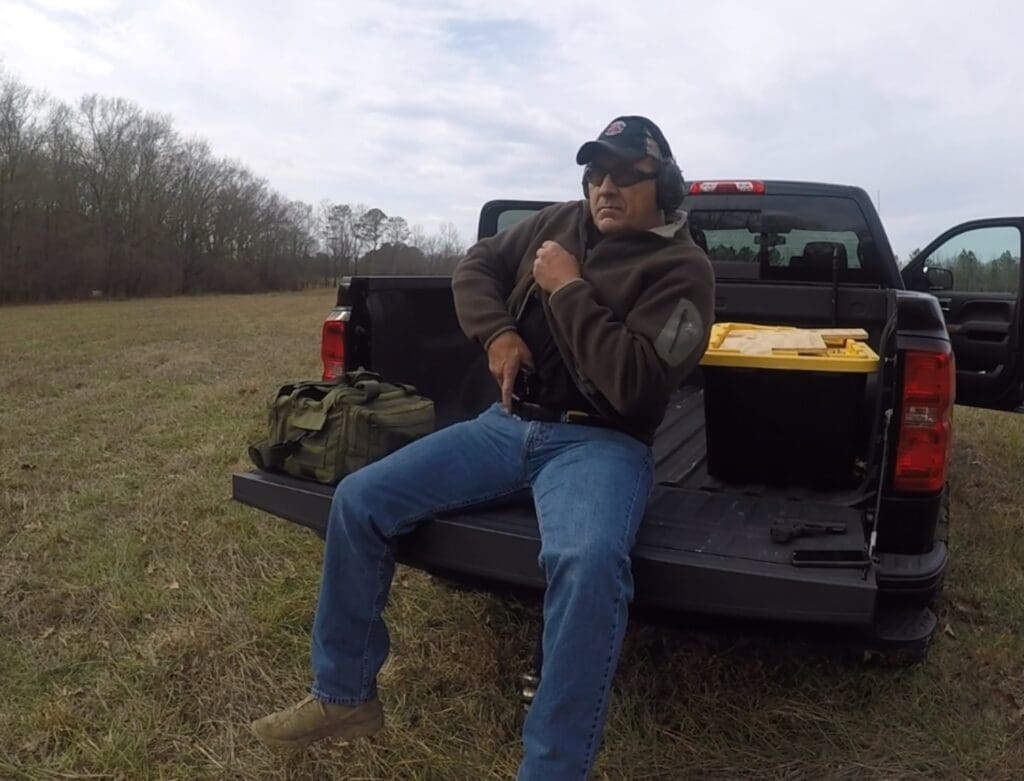
- Establish your master grip on the pistol while it is still in the holster.
- Clear the cover garment aggressively with the support hand and pin it high out of the way.
- Draw straight up until the muzzle clears the holster.
- Rotate the muzzle toward the target as the pistol rises.
- Join the hands at the centerline or just in front of the chest.
- Drive the pistol out to extension or stop at a compressed ready as needed.
- Acquire sights or optic, then press the trigger only if justified.
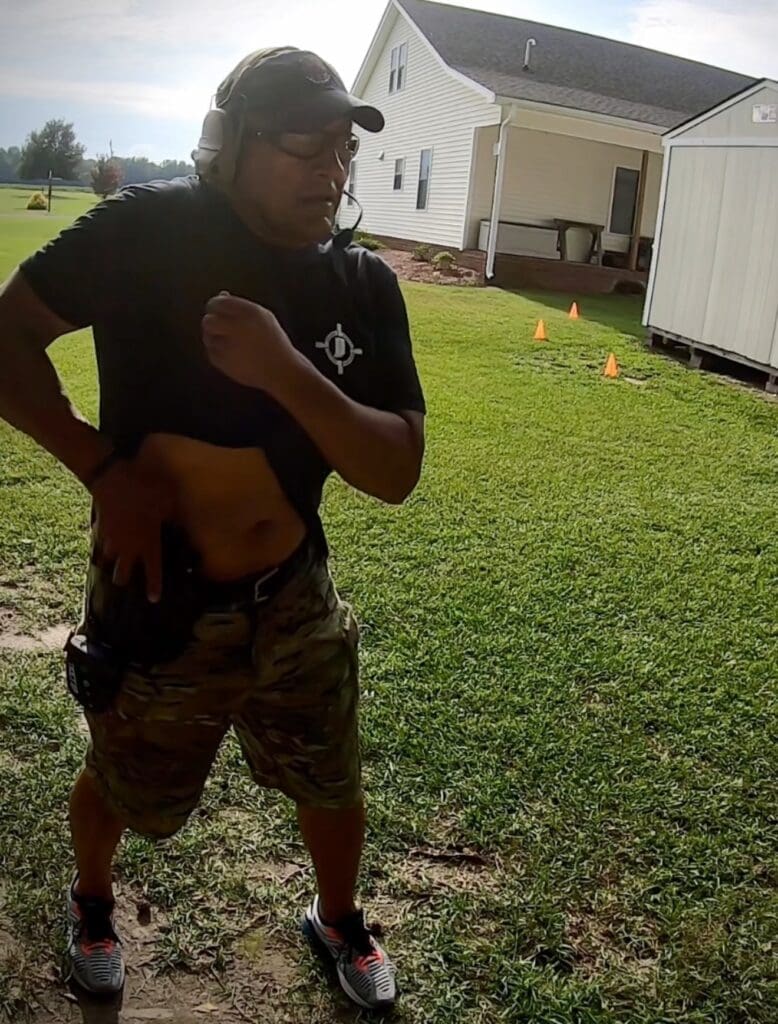
What matters most
The grip must be complete before the gun leaves the holster. If you adjust the grip after the draw, you lose speed and control.
After a high-stress or life-threatening event, your body is still in fight-or-flight mode. If you don’t consciously reset, you stay locked into tunnel vision, auditory exclusion, and poor decision-making.
Appendix-specific safety
The most dangerous part is usually when reholstering, not drawing. When your life is threatened, your body activates the flight of fight response, releasing hormones like adrenaline and cortisol. This increases heart rate, sharpens senses, and diverts blood flow to major muscle groups to prepare for action.
After a high-stress or life-threatening event, your body is still in fight-or-flight mode. If you don’t consciously reset, you stay locked into tunnel vision, auditory exclusion, and poor decision-making.
“SCAN. BREATHE. RESET.” – Scan and Breathe resets the system.
- Scan
- Break tunnel vision. Don’t just look over your shoulder, move your eyes, turn your head and move your feet to check left, right, behind, near, far (up/down where applicable).
Look for:- Additional threats
- Secondary attackers
- Changing terrain or environment
- Breathe
You may not realize it—but you have likely stopped breathing.
Force it:- Inhale through the nose (4 seconds)
- Hold (2–4 seconds)
- Exhale slow through the mouth (6–8 seconds)
- Reset
Bring your brain back online.
Expand awareness beyond the immediate threat:- Who else is present?
- What just changed?
- What’s your next move?
Now that you have determined that there is no longer a threat…reholster
- Bring the pistol back to a high ready or chest index.
- Contrary to what you may have heard from other “professionals,” it’s okay to look the pistol into the holster. Remember that you’re only reholstering when there is no longer a threat. Don’t take forever but make reholstering a deliberate action.
- Move clothing clear with the support hand.
- Slowly seat the pistol into the holster.
- Stop immediately if anything catches.
Never force the gun into the holster. Shirt tails, drawstrings, jacket cords, and even soft holsters cause problems.
“Live fire and dry fire practice minimizes the potential for all these common mistakes”
Common mistakes
- Fishing for the grip instead of building it cleanly.
- Remedy: practice with live fire on the range and dry fire.
- Not clearing the garment high enough.
- Remedy: practice with live fire on the range and dry fire.
- Bowling the gun outward instead of lifting straight up first.
- Remedy: practice with live fire on the range and dry fire.
- Trigger finger entering the trigger guard early.
- Remedy: practice with live fire on the range and dry fire.
- Speed reholstering.
- Remedy: practice with live fire on the range and dry fire.
- Using a flimsy holster.
- Do your homework and educate yourself on pistol carry holster options.
Dry practice drills
Use an unloaded pistol, no ammo in the room.
- 10 slow perfect reps of garment clear and master grip.
- 10 reps of draw to chest index.
- 10 reps of full presentation with sight picture.
- 10 reps of deliberate reholstering.
Focus on smoothness first. Speed comes from consistency.
Live-fire progression
Start from concealment at close range. Depending on your gun range, you may be required to take a concealed carry class or drawing from a holster class before being allowed to do this on your own. Check your local range rules and requirements and use the crawl – walk – run progressive training method to become proficient.
- One shot from the draw
- Two shots from the draw
- Failure drill
- Draw to first accurate hit on an 8-inch circle
- Seated draw if your range allows it
Track clean hits, not just time.
Appendix carry gear notes
Best setup is usually:
- Quality Kydex holster or specifically designed clothing for concealed carry
- full trigger coverage
- adjustable retention
- concealment claw or wing
- belt wedge if needed for comfort and concealment
Bottom line
Appendix carry works extremely well for everyday pistol carry if your gear is solid and your drawstroke is disciplined. Fast draw, slow reholster, no shortcuts.
“Carrying a pistol doesn’t make you prepared. Training does”
~ Ninja