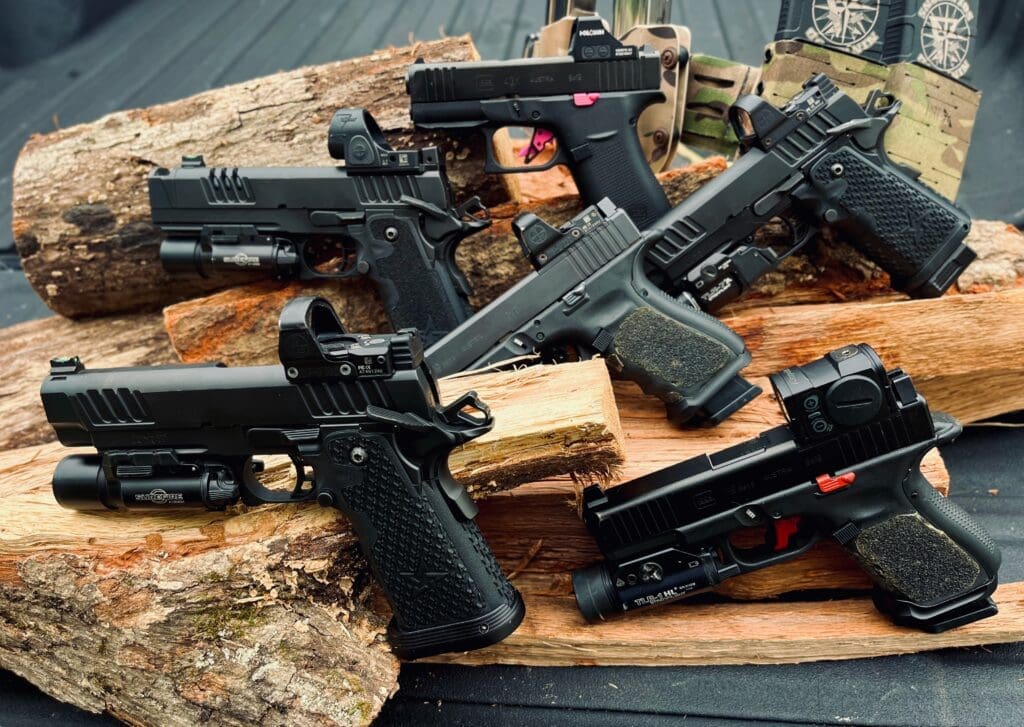

Red dots – Green dots – Iron sights.
Commentary/Analysis by Bob “Ninja” Porras April 19, 2026
Your use case should determine your equipment, not the other way around.
The pistol optic market is full of options, and more choices do not make the decision easier. Brand names, price tags, and hype do not matter as much as mission, environment, vision, and training volume. While this article references “pistol” optics, the same principles apply to rifle optics. Selecting a red dot for a rifle involves additional considerations and will be addressed separately, including both primary and backup sighting solutions.
Unfortunately, there is no universal solution. You’re going to have to put in the research and do some homework yourself to find the right solution. Red dots, green dots, and iron sights all have strengths and limitations. None of them are shortcuts to accuracy. They are tools, and every tool is only as effective as the shooter behind it. Fundamentals still matter. Grip, presentation, sight discipline, trigger control, and consistent practice remain non-negotiable.
The shooter who does not train will struggle no matter what is mounted on the gun.
With proper training, most drawbacks can be managed, and most advantages can be maximized. The goal is not to chase trends. The goal is to identify what works best for your needs, then train with it until performance becomes consistent and automatic.
Equipment does not create performance. Training does.
Instead of asking which optic is better?” Decide for yourself, “Which system will enable me to perform – consistently, under pressure, in my environment?”
One thing to keep in mind while researching: the firearms space is full of strong opinions. Some are earned through experience. Others are driven by marketing.
Not every “expert” is objective.
“This guide is built to cut through that noise and give you a practical framework to make an informed decision based on your needs – not someone else’s agenda. The views expressed here are my own and do not reflect those of any specific manufacture or organization. This is the result of 35 years of R&D, issued duty carry, personal EDC optics, range training, and competitions that I’ve either taught, hosted or participated in.”
For clarity, we’ll focus on the two most common color options: red and green dot optics.
Key Differences Between Red and Green Dots
Green dot optics are generally preferred for bright daylight and outdoor shooting. The human eye is more sensitive to green wavelengths, making the reticle appear brighter and often sharper—especially for users with astigmatism.
Red dot optics perform exceptionally well in low-light conditions and indoor environments. They typically offer longer battery life and are widely compatible with night vision devices.
Advantages and Limitations
Green Dot Optics
- High visibility in bright daylight
- Faster target acquisition outdoors
- May blend into green backgrounds
- Reduced eye strain for astigmatism
- Higher cost and fewer options
- Shorter battery life
Red Dot Optics
- Excellent in low light and indoor settings
- Can appear dim in bright sunlight
- Compatible with night vision
- May blur for some users with astigmatism
- More affordable and widely available
- Longer battery life (often 20,000+ hours)
Practical Recommendations
- Outdoor shooting or hunting: Green dot is often preferred.
- Home defense or low-light use: Red dot is typically the better choice.
Feature Comparison
|
Feature |
Green Dot |
Red Dot |
|
Lighting |
Bright daylight |
Low light / indoor |
|
Astigmatism |
Sharper appearance |
May blur |
|
Battery Life |
Shorter |
Longer |
|
Cost |
Higher |
More affordable |
Final Thoughts
The best optic is the one that performs reliably for your vision, your environment, and your intended use. Selection should be based on function—not preference or popularity.
Red dots have been the dominant choice for decades across military, law enforcement, and civilian shooters.
Why red dominates: Proven track record – long history in combat and duty use, Battery efficiency – longer runtimes vs most green emitters, Availability – more models, price points, and mounting options, Durability – widely vetted under hard use, Training standard – most instructors and programs are built around red
Bottom line: If you walk into a unit, agency, or serious training environment, red is still the baseline.
Why shooters choose green: Perceived brightness – the human eye picks up green faster, Better for some vision types – especially astigmatism in certain cases, Daylight visibility – can stand out more in bright conditions, Faster acquisition (for some) – easier to “find the dot” under stress.
Bottom line: Green is not niche anymore, and it’s still not the dominant standard.
Whenever possible, evaluate optics in person before making a purchase. Most retailers will allow you to handle optics prior to mounting. When doing so:
- Hold the optic at full presentation (arm’s length), consistent with how it will be used on a pistol or rifle and view the dot against a variety of backgrounds inside the store
- If available, look outside to assess performance in natural light and at distance
- Observe how the reticle appears under different lighting conditions and contrast levels in bright light, shadows and mixed environments.
Take time to operate the controls:
- Ensure brightness adjustments are intuitive and accessible
- Confirm the interface is simple and efficient to use
- Verify that the dot is clear and usable for your vision
A properly selected optic should integrate seamlessly with your shooting process – not require adaptation under stress.
Make an informed decision and test all options in person whenever possible – your eyes and environment will determine the best fit.
It’s not the optic. It’s not the brand. It’s not the price. It’s how you train
~ Ninja